Saturday, March 14, 2009
One that got away: El Tri
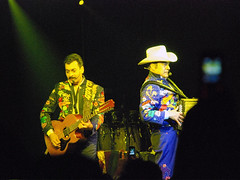
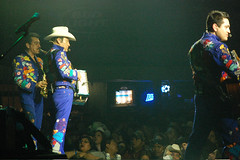
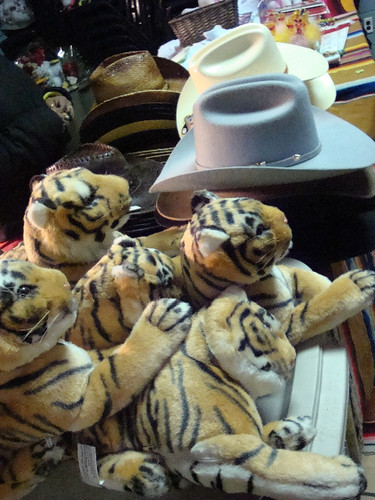
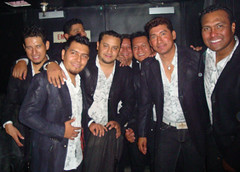
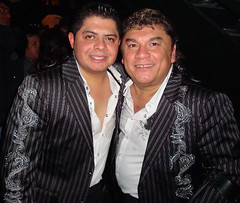
Why doesn't Disco Rodeo have a website? Because they can pack the place without bothering to let the gringos know that El Tri is in town. I hear...I hear, they played there last night.
I really should listen to the radio more often. Mexican acts promote through three main means: Hispanic media (Que Pasa newspaper, La Ley 96.9 FM), physical postering at tiendas, and word of mouth. Zero web presence. Perhaps I need to increase my word of mouth presence; get a stringer on the street who, for a nominal subscription fee, would keep Onda Carolina up to date. This is one information gap Lisa and I intended to bridge, or at least make inroads, when we started the blog. But it takes time to chase down information at tiendas every week.
It would be nice to somehow make more connections between the two entertainment economies, the Hispanic word-of-mouth market, and the "mainstream" one where the threshold of expectation is that there will at least be an internet presence, maybe even a Facebook page. Mainstream promoters are often interested in breaking into this market, but it's a communications gap as well as, often, a cultural one.
Easier said than done. Still, this is a good reminder to keep trying harder.
I really should listen to the radio more often. Mexican acts promote through three main means: Hispanic media (Que Pasa newspaper, La Ley 96.9 FM), physical postering at tiendas, and word of mouth. Zero web presence. Perhaps I need to increase my word of mouth presence; get a stringer on the street who, for a nominal subscription fee, would keep Onda Carolina up to date. This is one information gap Lisa and I intended to bridge, or at least make inroads, when we started the blog. But it takes time to chase down information at tiendas every week.
It would be nice to somehow make more connections between the two entertainment economies, the Hispanic word-of-mouth market, and the "mainstream" one where the threshold of expectation is that there will at least be an internet presence, maybe even a Facebook page. Mainstream promoters are often interested in breaking into this market, but it's a communications gap as well as, often, a cultural one.
Easier said than done. Still, this is a good reminder to keep trying harder.
Friday, March 13, 2009
Dancing in the D.R.
Does anyone have tips on where to go dancing and/or hear live music in the Dominican Republic? This query has come in from a reader:
Please share in the comments section!
Updates...
Ok, Salsonero suggests the "only disco grotto in the world"--with a website: Guácara Taína in Santo Domingo.
OC pal Steve seconds that recommendation ("how can you resist saying you danced in a cave?"), and adds two more:
"We want our four days there to be very much centered around dancing and music. We're hoping to dance with the locals and experience the roots of merengue and bachata firsthand!"
Please share in the comments section!
Updates...
Ok, Salsonero suggests the "only disco grotto in the world"--with a website: Guácara Taína in Santo Domingo.
OC pal Steve seconds that recommendation ("how can you resist saying you danced in a cave?"), and adds two more:
1) La Sartén
Hostos 153
Santo Domingo
"Tiny hole in the wall salsa/merengue club where you can see mostly middle aged and up folks dancing old school. It's like going back in time 30 years. Bring hearing protection, it's loud, even out on the sidewalk, where a large part of the dancing takes place. When I was there, this place was strictly for locals, but I heard a rumor a while back that somebody was taking tourists there. Hard to imagine, but times change. This is in the old center (Zona Colonial)."
2) Kantabar Plaza Unicentro
Av. 27 de Febrero esq. Abraham Lincoln, Unicentro Plaza, Santo Domingo, Republica Dominicana
809-565-1484
"This is actually a Karaoke place, something that I'm typically not really into. Got dragged there, I thought I'd hate it, but ended up loving it. You can see ordinary folks letting their hair down and going through the classics. Looking on the web, it looks like they may have at least 2 locations now, so I hope this is the right one. Lots of dancing going on."
Wednesday, March 11, 2009
Salsa Producer Ralph Mercado Dies, 67

Photo © by Martin Cohen, used by permission.
Mercado pictured in 2001.
Word is circulating that salsa producer Ralph Mercado, head of the RMM label in the '90s, has passed away.
Said musician Bobby Matos in a public forum on Yahoo:
"I understand that Ralphie was controversial and sometimes difficult but he was very important in the careers of a number of our great musicians. In addition to being a business person, I always found him interested in the people around him. Descansa en paz, Ralphie, Ibae (como dice los Lucumi)."
This obituary appeared yesterday in the Miami Herald.
Interesting obituary in the New York Daily News.
This 2001 article in the New York Times gets into the nitty gritty of Mercado's business practices, including his bankruptcy that year, lawsuits over copyright infringement and unpaid royalties, and loss of RMM.
This appreciation of the industry giant (en Español) by Josue Rivas appears in La Opinion.
Aurora Flores wrote this story with many details about Mercado's career in 2006. At the time, he was recovering from cancer surgery.
Developing...
RADIO ALERT: This SUNDAY (3/15), 4-6 pm Rocky Mountain Time [6-8 pm Eastern Time], Denver DJ Arturo Gomez will be paying tribute to Ralph Mercado on the KUVO program "Salsa con Jazz." He will give retrospective spins from labels RMM and Tropijazz, and artists such as Celia Cruz, Tito Puente, Eddie Palmieri, Hilton Ruiz and more.
jazz at the franklin
Brevan Hampden & Friends played at the Franklin Hotel Sunday night...
Brevan led from the drumset, occasionally spelled by trombonist Ryan Robinson, so Brevan could play congas. Mark Wells played piano and sang; what a lovely voice. Al Strong, Brevan's bandmate in Orquesta GarDel, was there with his trumpet, and Brian Horton with his elegant inventions on tenor sax. Sitting in (between bites of a tasty looking burger) was Barney Branch on alto sax. Mitch Butler too, who is working long distance on his doctorate in trombone performance at UT-Austin.

Someone had birthday cake; all of us got our just desserts.
Brevan led from the drumset, occasionally spelled by trombonist Ryan Robinson, so Brevan could play congas. Mark Wells played piano and sang; what a lovely voice. Al Strong, Brevan's bandmate in Orquesta GarDel, was there with his trumpet, and Brian Horton with his elegant inventions on tenor sax. Sitting in (between bites of a tasty looking burger) was Barney Branch on alto sax. Mitch Butler too, who is working long distance on his doctorate in trombone performance at UT-Austin.

Someone had birthday cake; all of us got our just desserts.
Tuesday, March 10, 2009
Mexico City at the Nasher through June 7
Link: My story about the exhibition in This Month at Duke
WHAT: Escultura Social: A New Generation of Art from Mexico City
WHERE: Nasher Museum of Art, 2001 Campus Dr. (corner Anderson), Duke University
WHEN: Jan. 15 - June 7, 2009 (Closed Mondays)
MUSEUM ADMISSION: Adults $5; Senior adults and Duke Alumni with card $4; non-Duke students with ID $3; Duke students, faculty and staff with ID, Durham city residents with ID, and Children 16 and younger FREE.
General Admission is FREE on Thursdays from 5 to 9 p.m.
Labels:
campus and community,
Durham,
links,
Mexico,
museums and galleries,
video
Sunday, March 8, 2009
Arturo O'Farrill on Democracy Now
Grammy winner Arturo O'Farrill, who leads the Afro-Latin Jazz Orchestra, son of Chico O'Farrill, is interviewed here at Democracy Now in support of easing travel restrictions to Cuba.
Thanks to Mappy Torres for the heads up.
Link: Here is the Letter to President Obama from U.S. Artists, Arts Presenters, Arts Educators and Cultural Scholars in support of Cultural Relations with Cuba, referenced by Democracy Now's Amy Goodman in Arturo's interview.
Thanks to Mappy Torres for the heads up.
Link: Here is the Letter to President Obama from U.S. Artists, Arts Presenters, Arts Educators and Cultural Scholars in support of Cultural Relations with Cuba, referenced by Democracy Now's Amy Goodman in Arturo's interview.
Friday, March 6, 2009
BREAKING: Live Bandoneon on 9th St - SATURDAY
Thankfully we can re-run this for today--Saturday, 3/7. Apologize for the false alert last night. The details from Triangle Tango are below. If you want to have dinner at Metro 8 in conjunction with this milonga, reservations are recommended.
*******
Breaking news from the live tango frontline:
That source prefers to remain on the downlow. Do your own digging.
Update: Eric did, and found this link:
*******
Breaking news from the live tango frontline:
"Bandeonista Osvaldo Barrios will be playing at the milonga at the Metro 8 restaurant on 9th St. [in Durham] tonight. The milonga runs from 9 pm -2 am but i haven't been able to get a fix on when exactly Barrios will be playing."
That source prefers to remain on the downlow. Do your own digging.
Update: Eric did, and found this link:
"Triangle Tango and tangueros, Dan Plonski & Eduardo Lazarowski, are excited to be hosting bandoneon player, Osvaldo Barrios, at Metro 8, Saturday March 7th.
Osvaldo is originally from Argentina and has been playing the bandoneon since the age of 12. He has performed with many orchestras including, Miguel Calo, Mariana Mores, Jorge Caldara, and Mario DeMarco. More information on Osvaldo’s career can be found at www.bandoneonbarrios.com.
Thierry Olivry will DJ between the live music sets. Dancing is from 9 p.m. - 2 a.m. Admission is $8."
Thursday, March 5, 2009
Shaheen & ASWAT Orchestra WORLD PREMIERE Tonight
Concert Review added...scroll down.

The last few days hanging out at Duke, I've been trying to learn Simon Shaheen's musicians by name, the instruments they play, and grasp just the tip of the iceberg of Arabic music. 16 musicians arrived Monday at Duke--from L.A., Boston, New York, Lebanon, Tunisia--and have been rehearsing like mad on a program of classical Arabic music from the "Golden Age." Apparently this refers to a golden age for cinema and movie music, in the Egyptian film industry of the 1930s-1960s. The concert tonight (Page Auditorium, 8 pm, Duke Performances) will also feature video projections of rare movie clips to go along with the music.

Jamal Senno plays the zither-like qanoun.
The four vocalists, 2 male and 2 female, all came from overseas. I've only heard Sonia M'Barek (gorgeous voice) and Ibrahim Azzam in rehearsal, and can't wait to hear Rima Khcheich and Khalil Abonula, who I'm told are also great. No doubt. This is an ensemble of first class cats, many of whom turned down other gigs to do the 20-day U.S. tour with Shaheen. Duke Performances shared this personnel list:
Welcome to the world of transliterated Arabic: I've found alt spellings for artist's names (what they tell me and what is on their Facebook page sometimes varies from the artist management's travel manifest), and for the names of instruments, and so I'm going to just print what people have told me and allow that there is some variation.

Tomas Ulrich, cello, Zafer Tawil and Michel Merhej Baklouk, percussion
As you can see from that list, many, if not most of these musicians are multi-instrumentalists. So for instance, Zafer Tawil is one of the two percussionists, but is also adept at oud, violin, etc. I'm not sure if I photographed Bassam Saba with a violin in rehearsal at one point, in addition to Western flute and Arabic reed flute(or nay/nye), but I wouldn't be surprised. (Saba is a member of Silk Road Project, and Shaheen's Quantara and Near Eastern Music Ensemble.) All three Shaheen brothers, Simon, Najib and William, play both oud and violin. (Najib is a master luthier, while William sidelines as an optometrist.) I've played a violin in my life and know that this is obviously not the same technique at all. [Although a local musician I talked to at the gig pointed out, both are fretless and have a neck and fingerboard of similar size.] I find it intriguing that this is a common prerequisite for these Arabic musicians, who must have a well-rounded approach to the music that would come from mastering very different techniques to achieve the same ends. While it's not completely rare in Latin, jazz or classical circles, it's certainly more typical for instrumentalists to specialize in one instrument, or in instruments with a similar technique (i.e. trumpet/flugelhorn/valve trombone, saxophones/flutes, etc.)
UPDATE - Concert Review, added 3/6:
"ASWAT (Voices): Celebrating the Golden Age of Arab Music" was a monumental concert event, 3 hours of music with intermission, and well worth being among the first to hear it last night in Duke University's Page Auditorium.
"You are going to hear the best voices in the Arab World," Simon Shaheen said, and he wasn't kidding. The first half of the program featured the exquisite Khalil Abonula and Rima Khcheich, performing individually and then as a duet. Part two followed a similar format, with Sonia M'Barek followed by Ibrahim Azzam, closing with a duet.
Before they played, a short segment of film clips introduced us to stars of the Egyptian film industry who first sang these tunes on screen and, via the magic of mass culture, popularized them throughout the Arab world. A montage of the images and voices of Egytian stars Um Kulthum and Mohammad Abdel Wahhab, the Lebanese diva Fairuz and Syrian movie star and composer Farid Al Atrash, among others, flashed onscreen above the musicians, and were referenced briefly throughout the evening as new singers took on their roles. [It occurred to me during the program that one could do something similar with the Mexican film industry.]
Farid Al Atrash with bellydancer Samia Gamal in 1950
The musicians wore black tie without the tie, but Simon proved very down-to-earth as he spoke with the audience to introduce the program. (That's the vibe I got from them throughout their visit; friendly and unpretentious, with a low-key sense of humor). It's not for nothing Shaheen is considered an ambassador for Arabic music; not only is he a multi-ensemble leader and performer, but since 1996 he has organized an annual workshop retreat in Arabic music at Mt. Holyoke College.
Program Notes:
Part 1
They opened with an instrumental arrangement of "Fakkaruni" (Remind Me) by Mohammed Abdel Wahhab. It seems not uncommon for an Arabic music audience, like a jazz audience, to applaud mid-way through a piece to acknowledge solos. Musicians will also express a word or gesture of appreciation for solos that are tasty or cooking; we witnessed both of these during this opening number.
Next, Khalid Abonula from Palestine sang a truly exquisite song called "Jannat" (Gardens), by Lebanese composer and singer Wadi' Al Safi to lyrics by Abdel Jalil Wihbeh. This was a slow piece with wrenchingly elaborate ornaments, and like all the singers, he was mighty and effortless. I can't interpret the words, yet I could really sense the storytelling energy behind his delivery. [Off the record: I ran into these guys at the grocery store a few nights earlier, and Khalid was stocking up on Kit Kats--could that be part of his regimen for maintaining his silky smooth voice, I wondered?]
Abonula followed that with an equal tour de force by the same songwriters, "Wayli Laou Yidrun," about a guy in love with a woman not approved of by his parents. Both of these opened with qanoun solos by Jamal Sinno, over a low drone in the violins. I don't know enough about the structure of this music to speak knowledgably about it, but I was trying to take notice. Mr. Abonula projected warmth and polish with a deep blue tie peeking out of a high-buttoned, long-cut jacket.
Lebanese singer Rima Khcheich ('Ka-shaysh') was introduced for the next two numbers. The petite Ms. Khcheich wore a simple all black emsemble of trousers, strapless top, and an airy, full-length wrap bordered in white or silver embroidery. She gestured emphatically, raising her upper arms near her head while singing, beginning with the long, intense 'Qasida' poem "Sakana I-Layl" (Calm Night), an Abdel Wahhab tune setting lyrics by Gibran Khalil Gibran.
Rima literally stole the show with an a capella interlude between that and her next number, "Il Wardi Gamil" (Lovely Flowers), an Um Kulthum hit in the 1947 film "Fatima." In the interlude, introduced by Simon's violin solo, Rima's high, ampflied solo voice, literally trembling at times, entranced everyone I talked to in the hall. It's worth noting that none of the singers read their parts from sheet music, and the intricate melodies and lyrics they have committed to memory is no doubt extensive.
Part one wrapped by bringing Khalil back out to sing with Rima an excerpt from a 1960s Lebanese musical about rural life, Sahrit Hubb (An Evening of Love), a TV sketch that originally starred Fairuz and Wadi' Al Safi.
Part 2
Again they opened with a sort of jam session [an Arab descarga, I thought], "Kahramana" by Farid Al Atrash [who looks a little like Tito Rodriquez in the film clips, in one of them wearing a tuxedo.] Solos in order, if I'm not mistaken, by: Jamal Sinno (qanoun = zither), Bassam Saba (nay = flute), Najib Shaheen (oud = lute), Kamil Shajrawi (violin). This tune is an instrumental dance number from a 1949 Egyptian film, "Afrita Hanim" (Jinni) starring Al Atrash and Samia Gamal.
Also of interest to me, as an aside, was how often the string players tuned up between numbers. With microtones in their scales and modes, I'm sure that pitch is an especially keen matter. I am not sure how the violins, cello and bass are tuned, i.e. if they vary from Western tuning, but it didn't sound like it as they were bowing their open fifths. However, that's just my guess. Also, I wondered how they play microtonal scales on the reed flute (nay/ney); I thought to look more closely and saw that Bassam had at least 6 nays on a table by his side. Are these keyed to different maqams, or what? Clearly I need to do more research.
The stately, emotive Sonia M'Barek came out next, looking like a queen in a pillar of aqua silk, to sing a really divine Arabic ode to Vienna. "Layalil 'Unsi Fi Vienna" (Merry Nights in Vienna) is in vals time, which Simon says is no stranger in Arab music. The tune comes from the 1944 film Gharam Wa Intiqam (Love and Revenge) starring Farid Al Atrash's sister, Asmahan.
Asmahan in one of the films that inspired ASWAT
Sonia then sang "Ana Fi Intidharak Malleit" (I Am Fed Up Waiting For You) which was another glorious highpoint of the evening. She emotes from deep within her body when she sings. Not to shortshrift the concert performance--you definitely got the feeling she gave her utmost to a live audience--but it's possible this tune was even more delicate and moving in the rehearsal, when the band and singers were without amplification. In any case, it moved listeners at the open rehearsal to spontaneous applause. M'Barek is Tunisian and has specialized in Tunisian and Andalucian music since she was a child.
"Ya Wardi Min Wishtirik" (The Flower Buyer) brought Palestinian singer Ibrahim Azzam to the stage next, in a bright yellow tie, and with a second oud in hand. They set him up troubadour style, standing at a pair of mics with one leg on a chair to support the oud. The song is an Abdel Wahhab tune, setting lyrics by Lebanese poet Bishara Al Khoury. It tells the story of a moody monologue by a young man, thinking about buying a flower for his beloved.
Next was "Ya 'Awathil Falfillu," another Farid tune from the 1950 film "Akhir Kithba" (Last Lie) that got the audience clapping. A brief oud solo from Najib was welcome, and the duelling ouds with Najib and Ibrahim was a real crowdpleaser.
The evening ended with a happy ending: "Ya Di n-Na'im" (Living in Happiness), from the 1938 film Yahyal Hubb (Love Wins) starring Layla Murad and Mohammed Abdel Wahhab. Sonia and Ibrahim sang this dialogue about reunited lovers.
A few sound problems got worked out in the first half, so the premiere should set them up well for their big coming out party in D.C. There was talk among the musicians of the program running long, so it could be that some numbers will get tightened up or cut during the tour. I don't know if the Arabic music scene is just super laidback about autographs or what, but the supporting musicians seemed very phlegmatic about signing CDs. They all referred me to Simon to do the honors. He did, with the graciousness he showed to everyone throughout his residency here. (And I even got Najib to throw his John Hancock on it in Arabic.) Thanks to ASWAT Orchestra for access to their practice sessions and a fantastic, extended play concert of rare music.
If you're in a touring city where tickets are still available, I definitely recommended you catch this, it's an epic work on the visionary scale of Wynton Marsalis' Congo Square with Yacub Addy, bringing together musicians it will be hard to catch together anywhere else. As someone new to traditional Arabic music, I found it accessible and entrancing; there can't be a better way to hear this music for the first time than live, by some of the best practitioners in the world. Fans of Arab music won't have to be told twice; ASWAT is a cultural experience not to be missed.
Links:
Simon Shaheen on WUNC's The State of Things
A story I wrote for Duke Today about Shaheen's reception on campus
Syrian Clarinettist Kinan Azmeh on Weekend Edition
NPR's Sampling of the Arabesque Festival in D.C.

The last few days hanging out at Duke, I've been trying to learn Simon Shaheen's musicians by name, the instruments they play, and grasp just the tip of the iceberg of Arabic music. 16 musicians arrived Monday at Duke--from L.A., Boston, New York, Lebanon, Tunisia--and have been rehearsing like mad on a program of classical Arabic music from the "Golden Age." Apparently this refers to a golden age for cinema and movie music, in the Egyptian film industry of the 1930s-1960s. The concert tonight (Page Auditorium, 8 pm, Duke Performances) will also feature video projections of rare movie clips to go along with the music.

Jamal Senno plays the zither-like qanoun.
The four vocalists, 2 male and 2 female, all came from overseas. I've only heard Sonia M'Barek (gorgeous voice) and Ibrahim Azzam in rehearsal, and can't wait to hear Rima Khcheich and Khalil Abonula, who I'm told are also great. No doubt. This is an ensemble of first class cats, many of whom turned down other gigs to do the 20-day U.S. tour with Shaheen. Duke Performances shared this personnel list:
Orchestra (12 members)
Kamil Shajrawi - violin
William Shaheen - violin
Abeeb Refela - violin
Georges Lammam - violin
Simon Shaheen - violin / oud
Najib Shaheen - oud
Bassam Saba - nay/flute
Jamal Sinno (alt spelling: Senno)- qanun
Tomas Ulrich - cello
Walid Zairi - bass
Michel Merhej Baklouk - percussion
Dafer Tawil (alt spelling: Zafer) - percussion
Vocalist (4 featured)
Ibrahim Azzam - vocal
Sonia M'Barek - vocal
Khalil Abonula - vocal
Rima Khcheich - vocal
Welcome to the world of transliterated Arabic: I've found alt spellings for artist's names (what they tell me and what is on their Facebook page sometimes varies from the artist management's travel manifest), and for the names of instruments, and so I'm going to just print what people have told me and allow that there is some variation.

Tomas Ulrich, cello, Zafer Tawil and Michel Merhej Baklouk, percussion
As you can see from that list, many, if not most of these musicians are multi-instrumentalists. So for instance, Zafer Tawil is one of the two percussionists, but is also adept at oud, violin, etc. I'm not sure if I photographed Bassam Saba with a violin in rehearsal at one point, in addition to Western flute and Arabic reed flute(or nay/nye), but I wouldn't be surprised. (Saba is a member of Silk Road Project, and Shaheen's Quantara and Near Eastern Music Ensemble.) All three Shaheen brothers, Simon, Najib and William, play both oud and violin. (Najib is a master luthier, while William sidelines as an optometrist.) I've played a violin in my life and know that this is obviously not the same technique at all. [Although a local musician I talked to at the gig pointed out, both are fretless and have a neck and fingerboard of similar size.] I find it intriguing that this is a common prerequisite for these Arabic musicians, who must have a well-rounded approach to the music that would come from mastering very different techniques to achieve the same ends. While it's not completely rare in Latin, jazz or classical circles, it's certainly more typical for instrumentalists to specialize in one instrument, or in instruments with a similar technique (i.e. trumpet/flugelhorn/valve trombone, saxophones/flutes, etc.)
UPDATE - Concert Review, added 3/6:
"ASWAT (Voices): Celebrating the Golden Age of Arab Music" was a monumental concert event, 3 hours of music with intermission, and well worth being among the first to hear it last night in Duke University's Page Auditorium.
"You are going to hear the best voices in the Arab World," Simon Shaheen said, and he wasn't kidding. The first half of the program featured the exquisite Khalil Abonula and Rima Khcheich, performing individually and then as a duet. Part two followed a similar format, with Sonia M'Barek followed by Ibrahim Azzam, closing with a duet.
Before they played, a short segment of film clips introduced us to stars of the Egyptian film industry who first sang these tunes on screen and, via the magic of mass culture, popularized them throughout the Arab world. A montage of the images and voices of Egytian stars Um Kulthum and Mohammad Abdel Wahhab, the Lebanese diva Fairuz and Syrian movie star and composer Farid Al Atrash, among others, flashed onscreen above the musicians, and were referenced briefly throughout the evening as new singers took on their roles. [It occurred to me during the program that one could do something similar with the Mexican film industry.]
Farid Al Atrash with bellydancer Samia Gamal in 1950
The musicians wore black tie without the tie, but Simon proved very down-to-earth as he spoke with the audience to introduce the program. (That's the vibe I got from them throughout their visit; friendly and unpretentious, with a low-key sense of humor). It's not for nothing Shaheen is considered an ambassador for Arabic music; not only is he a multi-ensemble leader and performer, but since 1996 he has organized an annual workshop retreat in Arabic music at Mt. Holyoke College.
Program Notes:
Part 1
They opened with an instrumental arrangement of "Fakkaruni" (Remind Me) by Mohammed Abdel Wahhab. It seems not uncommon for an Arabic music audience, like a jazz audience, to applaud mid-way through a piece to acknowledge solos. Musicians will also express a word or gesture of appreciation for solos that are tasty or cooking; we witnessed both of these during this opening number.
Next, Khalid Abonula from Palestine sang a truly exquisite song called "Jannat" (Gardens), by Lebanese composer and singer Wadi' Al Safi to lyrics by Abdel Jalil Wihbeh. This was a slow piece with wrenchingly elaborate ornaments, and like all the singers, he was mighty and effortless. I can't interpret the words, yet I could really sense the storytelling energy behind his delivery. [Off the record: I ran into these guys at the grocery store a few nights earlier, and Khalid was stocking up on Kit Kats--could that be part of his regimen for maintaining his silky smooth voice, I wondered?]
Abonula followed that with an equal tour de force by the same songwriters, "Wayli Laou Yidrun," about a guy in love with a woman not approved of by his parents. Both of these opened with qanoun solos by Jamal Sinno, over a low drone in the violins. I don't know enough about the structure of this music to speak knowledgably about it, but I was trying to take notice. Mr. Abonula projected warmth and polish with a deep blue tie peeking out of a high-buttoned, long-cut jacket.
Lebanese singer Rima Khcheich ('Ka-shaysh') was introduced for the next two numbers. The petite Ms. Khcheich wore a simple all black emsemble of trousers, strapless top, and an airy, full-length wrap bordered in white or silver embroidery. She gestured emphatically, raising her upper arms near her head while singing, beginning with the long, intense 'Qasida' poem "Sakana I-Layl" (Calm Night), an Abdel Wahhab tune setting lyrics by Gibran Khalil Gibran.
Rima literally stole the show with an a capella interlude between that and her next number, "Il Wardi Gamil" (Lovely Flowers), an Um Kulthum hit in the 1947 film "Fatima." In the interlude, introduced by Simon's violin solo, Rima's high, ampflied solo voice, literally trembling at times, entranced everyone I talked to in the hall. It's worth noting that none of the singers read their parts from sheet music, and the intricate melodies and lyrics they have committed to memory is no doubt extensive.
Part one wrapped by bringing Khalil back out to sing with Rima an excerpt from a 1960s Lebanese musical about rural life, Sahrit Hubb (An Evening of Love), a TV sketch that originally starred Fairuz and Wadi' Al Safi.
Part 2
Again they opened with a sort of jam session [an Arab descarga, I thought], "Kahramana" by Farid Al Atrash [who looks a little like Tito Rodriquez in the film clips, in one of them wearing a tuxedo.] Solos in order, if I'm not mistaken, by: Jamal Sinno (qanoun = zither), Bassam Saba (nay = flute), Najib Shaheen (oud = lute), Kamil Shajrawi (violin). This tune is an instrumental dance number from a 1949 Egyptian film, "Afrita Hanim" (Jinni) starring Al Atrash and Samia Gamal.
Also of interest to me, as an aside, was how often the string players tuned up between numbers. With microtones in their scales and modes, I'm sure that pitch is an especially keen matter. I am not sure how the violins, cello and bass are tuned, i.e. if they vary from Western tuning, but it didn't sound like it as they were bowing their open fifths. However, that's just my guess. Also, I wondered how they play microtonal scales on the reed flute (nay/ney); I thought to look more closely and saw that Bassam had at least 6 nays on a table by his side. Are these keyed to different maqams, or what? Clearly I need to do more research.
The stately, emotive Sonia M'Barek came out next, looking like a queen in a pillar of aqua silk, to sing a really divine Arabic ode to Vienna. "Layalil 'Unsi Fi Vienna" (Merry Nights in Vienna) is in vals time, which Simon says is no stranger in Arab music. The tune comes from the 1944 film Gharam Wa Intiqam (Love and Revenge) starring Farid Al Atrash's sister, Asmahan.
Asmahan in one of the films that inspired ASWAT
Sonia then sang "Ana Fi Intidharak Malleit" (I Am Fed Up Waiting For You) which was another glorious highpoint of the evening. She emotes from deep within her body when she sings. Not to shortshrift the concert performance--you definitely got the feeling she gave her utmost to a live audience--but it's possible this tune was even more delicate and moving in the rehearsal, when the band and singers were without amplification. In any case, it moved listeners at the open rehearsal to spontaneous applause. M'Barek is Tunisian and has specialized in Tunisian and Andalucian music since she was a child.
"Ya Wardi Min Wishtirik" (The Flower Buyer) brought Palestinian singer Ibrahim Azzam to the stage next, in a bright yellow tie, and with a second oud in hand. They set him up troubadour style, standing at a pair of mics with one leg on a chair to support the oud. The song is an Abdel Wahhab tune, setting lyrics by Lebanese poet Bishara Al Khoury. It tells the story of a moody monologue by a young man, thinking about buying a flower for his beloved.
Next was "Ya 'Awathil Falfillu," another Farid tune from the 1950 film "Akhir Kithba" (Last Lie) that got the audience clapping. A brief oud solo from Najib was welcome, and the duelling ouds with Najib and Ibrahim was a real crowdpleaser.
The evening ended with a happy ending: "Ya Di n-Na'im" (Living in Happiness), from the 1938 film Yahyal Hubb (Love Wins) starring Layla Murad and Mohammed Abdel Wahhab. Sonia and Ibrahim sang this dialogue about reunited lovers.
A few sound problems got worked out in the first half, so the premiere should set them up well for their big coming out party in D.C. There was talk among the musicians of the program running long, so it could be that some numbers will get tightened up or cut during the tour. I don't know if the Arabic music scene is just super laidback about autographs or what, but the supporting musicians seemed very phlegmatic about signing CDs. They all referred me to Simon to do the honors. He did, with the graciousness he showed to everyone throughout his residency here. (And I even got Najib to throw his John Hancock on it in Arabic.) Thanks to ASWAT Orchestra for access to their practice sessions and a fantastic, extended play concert of rare music.
If you're in a touring city where tickets are still available, I definitely recommended you catch this, it's an epic work on the visionary scale of Wynton Marsalis' Congo Square with Yacub Addy, bringing together musicians it will be hard to catch together anywhere else. As someone new to traditional Arabic music, I found it accessible and entrancing; there can't be a better way to hear this music for the first time than live, by some of the best practitioners in the world. Fans of Arab music won't have to be told twice; ASWAT is a cultural experience not to be missed.
Links:
Simon Shaheen on WUNC's The State of Things
A story I wrote for Duke Today about Shaheen's reception on campus
Syrian Clarinettist Kinan Azmeh on Weekend Edition
NPR's Sampling of the Arabesque Festival in D.C.
Labels:
artist residencies,
campus and community,
Durham,
links,
middle eastern,
radio,
Tours,
video,
world music,
world premieres
Wednesday, March 4, 2009
Malaquias Montoya Gallery Reception Today
Dedication of the new Fredric Jameson Gallery in Duke's Friedl Building (formerly Duke Art Museum on East Campus) kicks off today with an opening and reception for Chicano graphic artist Malaquias Montoya's "Premeditated: Meditations on Capital Punishment."
WHAT: MALAQUIAS MONTOYA Opening & Reception
WHEN: Wednesday (3/4) Reception 5 pm, Gallery Talk by the Artist at 6 pm.
WHERE: Fredric Jameson Gallery, Friedl Building Room 115, Duke East Campus
COST: FREE, Open to the public.
Map of parking for this event on the East Campus Quad
Sponsored by Duke University's Program in Latino/a Studies in the Global South.
From exhibit web page:

From press release:
WHAT: MALAQUIAS MONTOYA Opening & Reception
WHEN: Wednesday (3/4) Reception 5 pm, Gallery Talk by the Artist at 6 pm.
WHERE: Fredric Jameson Gallery, Friedl Building Room 115, Duke East Campus
COST: FREE, Open to the public.
Map of parking for this event on the East Campus Quad
Sponsored by Duke University's Program in Latino/a Studies in the Global South.
From exhibit web page:

From press release:
"Montoya is a leading figure in the West Coast political Chicano graphic arts movement, a political and socially conscious movement that expresses itself primarily through the mass production of silk-screened posters. Montoya's works include acrylic paintings, murals, washes, and drawings, but he is primarily known for his silkscreen prints, which have been exhibited nationally as well as internationally. This exhibition features silkscreen images and paintings, and related text panels dealing with the death penalty and penal institutions--inspired by the escalation of deaths at the hands of the State of Texas in recent years. As Montoya states, 'We have perfected the art of institutional killing to the degree that it has deadened our national, quintessentially human, response to death. I want to produce a body of work depicting the horror of this act.'
Since 1989 Montoya has been a professor at the University of California, Davis. His classes, through the Departments of Chicana/o Studies and Art, include silkscreening, poster making and mural painting, and focus on Chicano culture and history. He is credited by historians as being one of the founders of the "social seriography" movement in the San Francisco Bay Area in the mid-1960s. His visual expressions, art of protest, depict the struggle and strength of humanity and the necessity to unite behind that struggle. Like many Chicano artists of his generation, Montoya's art is rooted in the tradition of the Taller de Grafica Popular, the Mexican printmakers of the 1920s, 30s and 40s, whose work expressed the need for social and political reform for the Mexican underprivileged. Montoya's work uses powerful images that are combined with text to create his socially critical messages.
The exhibit will be on display from the reception through April 17th and from mid-May through Mid-September. Hours from March 5 through April 17th are 10am - 5pm. Summer and fall hours to be determined - please check back on our website after April for those hours."
Cuba Travel Bill in Congress
Local agrarian Jeff Ensminger from Neemtree.org is sending around this call to action for Triangle residents:
You can read the the full text of the Freedom to Travel to Cuba Act here.
Constituents can email Congressman Price online here.
Not sure if you live in North Carolina's 4th district? Find out here.
CUBA Travel Bill H.R. 874
Please contact David Price's office in D.C. and ask that he Co-Sponsor and support this bill. Co-Sponsor is critical, he did it last year but he needs to be asked by constituents and he'll do it again. This takes minutes, please take the time.
Phone: (202) 225-1784 [call today]
Fax: (202) 225-2014
When/if you call a suggested talking point is:
I want to thank Congressman Price for supporting past Cuba-Related bills that have been before the House. I am asking now that he consider co-sponsorship of HR 874, and support this bill so that open dialogue and engagement may occur.
This bill will reinstate people to people exchange, make possible travel by families, increase amounts and times they are able to contribute to their families, loosen travel for our trade in Cuba in AG sales and reinstate academic travel without the current prohibitive restrictions.
Change is coming to Cuba. Your voice is needed now.
Thanks,
Jeff Ensminger
www.neemtree.org
Durham, NC
Member Latin America Working Group, ECDET and
Washington Office on Latin Affairs
You can read the the full text of the Freedom to Travel to Cuba Act here.
Constituents can email Congressman Price online here.
Not sure if you live in North Carolina's 4th district? Find out here.
Tuesday, March 3, 2009
Simon Shaheen Residency begins today at Duke
Oud and violin virtuoso Simon Shaheen, a seminal composer and performer of Arab music and world fusion, begins a brief artist residency at Duke this week. The public is invited to welcome Shaheen and members of his ASWAT Orchestra at a free reception this evening (Tues., 3/3) at 8 p.m. in the Mary Lou Williams Center for Black Culture.
On Wednesday (3/4) from 6-7:30 p.m., Page Auditorium will be open to the public for an open rehearsal of Shaheen's ensemble.
Duke Performances presents an 8 p.m. concert Thursday (3/5) in Page, where Shaheen will present the world premiere of "ASWAT (Voices): Celebrating the Golden Age of Arab Music," with featured vocalists Ibrahim Azzam, Sonia M'Barek, Khalil Abonula and Rima Khcheich.
Shaheen's massive new choral piece, backed by a 12-15 piece classical Arab orchestra, will travel from Duke directly to Washington D.C., where its performance is already sold out as part of the Kennedy Center's month-long festival "Arabesque: Arts of the Arab World."
The 53-year-old Shaheen has been called "one of the most dynamic musical links between the Arab world and the West." From a Palestinian musical family, he studied Western classical music in Haifa and the Academy of Music in Jerusalem, where he also taught. He entered the New York music scene when he came to the U.S. in 1980 to begin graduate studies at Columbia and the Manhattan School of Music. In the '90s, he founded his own classical ensemble of Arab music, NEME (Near Eastern Music Ensemble) and recorded several albums. In 2000, he saw the need for a thoughtful approach to world fusion, and created the jazz and Arab music ensemble Qantara (which translates as "arch").
As Shaheen told Afropop Worldwide at that time:
Developing...
More info:
Duke Performances Website
Simon Shaheen: Artist's Website
On Wednesday (3/4) from 6-7:30 p.m., Page Auditorium will be open to the public for an open rehearsal of Shaheen's ensemble.
Duke Performances presents an 8 p.m. concert Thursday (3/5) in Page, where Shaheen will present the world premiere of "ASWAT (Voices): Celebrating the Golden Age of Arab Music," with featured vocalists Ibrahim Azzam, Sonia M'Barek, Khalil Abonula and Rima Khcheich.
Shaheen's massive new choral piece, backed by a 12-15 piece classical Arab orchestra, will travel from Duke directly to Washington D.C., where its performance is already sold out as part of the Kennedy Center's month-long festival "Arabesque: Arts of the Arab World."
The 53-year-old Shaheen has been called "one of the most dynamic musical links between the Arab world and the West." From a Palestinian musical family, he studied Western classical music in Haifa and the Academy of Music in Jerusalem, where he also taught. He entered the New York music scene when he came to the U.S. in 1980 to begin graduate studies at Columbia and the Manhattan School of Music. In the '90s, he founded his own classical ensemble of Arab music, NEME (Near Eastern Music Ensemble) and recorded several albums. In 2000, he saw the need for a thoughtful approach to world fusion, and created the jazz and Arab music ensemble Qantara (which translates as "arch").
As Shaheen told Afropop Worldwide at that time:
"I've tried to come up with a formula that is original, interesting musically, but not harming the roots. So the qantara is a symbol of something that holds different things together, and when you go through it, you don't know what to expect inside. It's like a new world."
Developing...
More info:
Duke Performances Website
Simon Shaheen: Artist's Website
Monday, March 2, 2009
Lluvia...Con Nieve
I don't know who this family is, but, they have excellent taste in music for their home videos:
Mon Rivera! My thoughts exactly.
Enjoy your snow day, Durham!
Mon Rivera! My thoughts exactly.
Enjoy your snow day, Durham!
Thursday, February 26, 2009
Tropic Orchestra This Friday (2/27)
The Tropic Orchestra joins forces with DJ Salsa Mike this Friday for the "Fifth Friday" party at Carmen's Cuban Cafe. This newest ensemble playing salsa in the Triangle debuted on Valentine's Day. I was there and will publish more details shortly.
Vocalist/leader Ricardo Diquez says they have added a couple of new charts, and will play two sets, at approximately 11:00 pm and [corrected] 1:00 am.
More developing...
UPDATE (2/27):
Billy Marrero, the man with the golden güiro, will be joining Tropic Orchestra tonight. Billy joined Charanga Carolina (currently on hiatus) last fall and is pictured here, far left:
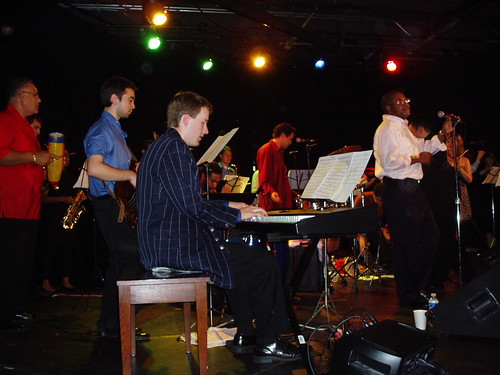
Other members of Tropic Orchestra include Jessie Rivera, bongocero, Sherry Damon and Christine Thompson, trombones, Abdala Villegas, timbales, Andrew Munger, congas, and vocalists Ricardo Diquez and Ivan Ramirez.
At their debut 2/14, these guys and gals had good, heavy flavor and charts selected from salsa dura classics that bode well for their aesthetic direction: Oscar D'Leon, El Gran Combo, Cortijo with El Sonero Mayor, Willie Colon with Hector Lavoe. There was a nice, mixed-generational crowd in attendance too, hearkening back to Montas and even Salsa Carolina days. So the vibe was right. It's nice to hear Ivan Ramirez, who I know only as a heavy metal bassist, singing lead. A nice counterpoint to the bright fire of Ricardo, who we knew as "TNT" in the early days of Samecumba. The band is still getting its sea legs on some of the arrangements and odd rhythm breaks, but with some rehearsal and communication they have the potential to work these things out. Sherry Damon, who teaches trombone at Mt. Olive College, already brings a formidable "dirty" sound to the Willie Colon moñas. The band does need to tune up secondary vocals on the coros, and keep that vital rhythm section together. My advice for the bandstand: Don't have too much fun yet. Always remember that playing salsa well is hard work. The best admonition comes from trombonist and ethnomusicologist Chris Washburne in his new book Sounding Salsa, echoing a famous Willie Colon album cover: "Play like there's a gun to your head!"

No doubt a demanding audience of salsa dancers will be there tonight to check it out.
WHAT: Tropic Orchestra
WHEN: live music 11pm-2am Friday (2/27)
WHERE: Carmen's Cuban Cafe
COST: $15 (student and military ID: $10)
Links:
The Tropic Orchestra's myspace page
Carolina Latin Social has made this a Meetup event.
Post-gig Playback (added 2/28):
Billy Marrero was a replacement for Jessie Rivera for this gig. A new pianist played also, Venezuelan Andres Leon. He played a couple of solos which provoked interest, the first in "Todo Tiene Su Final" started off abstract, held its own and developed into a decent, long solo. Nice to know another pianist in the area who can play a long solo. Tropic wrapped up its second set with a slow, dark cha cha in which Christine Thompson laid out a bluesy trombone solo. Leon again showed nice colors in a second solo that was the richest of the night.
Vocalist/leader Ricardo Diquez says they have added a couple of new charts, and will play two sets, at approximately 11:00 pm and [corrected] 1:00 am.
More developing...
UPDATE (2/27):
Billy Marrero, the man with the golden güiro, will be joining Tropic Orchestra tonight. Billy joined Charanga Carolina (currently on hiatus) last fall and is pictured here, far left:

Other members of Tropic Orchestra include Jessie Rivera, bongocero, Sherry Damon and Christine Thompson, trombones, Abdala Villegas, timbales, Andrew Munger, congas, and vocalists Ricardo Diquez and Ivan Ramirez.
At their debut 2/14, these guys and gals had good, heavy flavor and charts selected from salsa dura classics that bode well for their aesthetic direction: Oscar D'Leon, El Gran Combo, Cortijo with El Sonero Mayor, Willie Colon with Hector Lavoe. There was a nice, mixed-generational crowd in attendance too, hearkening back to Montas and even Salsa Carolina days. So the vibe was right. It's nice to hear Ivan Ramirez, who I know only as a heavy metal bassist, singing lead. A nice counterpoint to the bright fire of Ricardo, who we knew as "TNT" in the early days of Samecumba. The band is still getting its sea legs on some of the arrangements and odd rhythm breaks, but with some rehearsal and communication they have the potential to work these things out. Sherry Damon, who teaches trombone at Mt. Olive College, already brings a formidable "dirty" sound to the Willie Colon moñas. The band does need to tune up secondary vocals on the coros, and keep that vital rhythm section together. My advice for the bandstand: Don't have too much fun yet. Always remember that playing salsa well is hard work. The best admonition comes from trombonist and ethnomusicologist Chris Washburne in his new book Sounding Salsa, echoing a famous Willie Colon album cover: "Play like there's a gun to your head!"

No doubt a demanding audience of salsa dancers will be there tonight to check it out.
WHAT: Tropic Orchestra
WHEN: live music 11pm-2am Friday (2/27)
WHERE: Carmen's Cuban Cafe
COST: $15 (student and military ID: $10)
Links:
The Tropic Orchestra's myspace page
Carolina Latin Social has made this a Meetup event.
Post-gig Playback (added 2/28):
Billy Marrero was a replacement for Jessie Rivera for this gig. A new pianist played also, Venezuelan Andres Leon. He played a couple of solos which provoked interest, the first in "Todo Tiene Su Final" started off abstract, held its own and developed into a decent, long solo. Nice to know another pianist in the area who can play a long solo. Tropic wrapped up its second set with a slow, dark cha cha in which Christine Thompson laid out a bluesy trombone solo. Leon again showed nice colors in a second solo that was the richest of the night.
Wednesday, February 25, 2009
The many moods of Love
At the Toby Love show on Sunday, we saw both his softer and his "crunkier" side. Actually the term "crunkchata" seems a little hyped, as does calling this a "hiphop" blend. I would call it bachata romantica and draw a parallel to the commercialization of salsa romantica in the 90s. While it's true that Love's flygirls and b-boys inject "urban" Bronx-creole style and attitude, his singing comes straight from the annals of romantic R&B. Commercial bachata recordings are so smoothly tweaked nowadays that the live performance is a different experience entirely; the frenetic, in some ways mechanical, stage show devolved focus away from Love as a romantic persona, whose sexual energy onstage is more boy-band, more charming waif, than intensely hypnotic or commanding. By contrast, his rhythm section's mannish energy and muscularity is pure Dominicana, but there's nothing new about that.
This video of a bachata shows Love crafting his softer side. Without his dancers here, you can see how his band is put together and operates.
Softer side of Love from Santa Salsera on Vimeo.
Love was at his best when he dropped his romantic alter ego and turned the party crank, with some hyperactive merengue and rapidfire vocals:
Dame Agua from Santa Salsera on Vimeo.
The dance showcase that followed brought out another ancient piece of urban folklore: witty sexual hype. Here are three members of Love's crew "getting crazy":
Get Crazy #1 from Santa Salsera on Vimeo.
Get Crazy #2 from Santa Salsera on Vimeo.
Get Crazy #3 from Santa Salsera on Vimeo.
Links:
Read my concert review on the Indy online music blog SCAN
See photos from the live show posted earlier on Onda Carolina
This video of a bachata shows Love crafting his softer side. Without his dancers here, you can see how his band is put together and operates.
Softer side of Love from Santa Salsera on Vimeo.
Love was at his best when he dropped his romantic alter ego and turned the party crank, with some hyperactive merengue and rapidfire vocals:
Dame Agua from Santa Salsera on Vimeo.
The dance showcase that followed brought out another ancient piece of urban folklore: witty sexual hype. Here are three members of Love's crew "getting crazy":
Get Crazy #1 from Santa Salsera on Vimeo.
Get Crazy #2 from Santa Salsera on Vimeo.
Get Crazy #3 from Santa Salsera on Vimeo.
Links:
Read my concert review on the Indy online music blog SCAN
See photos from the live show posted earlier on Onda Carolina
Labels:
bachata,
Dominican Republic,
links,
live music,
media,
merengue,
Nueva York,
Raleigh,
reviews,
video
Tuesday, February 24, 2009
Tiger Beat
More love for Los Tigres del Norte.
Some excellent photos from Friday's show by my colleague Juan Manuel Cortez, posted here with his permission. Juan is a photographer and digital artist from Colombia who freelances for Que Pasa and other local media. He's also a friend of the local music scene. Check out his professional website here.


Now, a word or two must be said about my obsession with Los Tigres' sartorial splendor.
At this show, I was observing with considerable interest and admiration the fashion sense of this very youthful mexican-regional/norteño scene. I saw girls in the zip-up stiletto boots you see everywhere, but with western detailing. One young man who sticks out in my mind wore a light pinstripe suit, accessorized with a cowboy hat and belt in matching white (paging: Saturday Night Fever). Naturally cowboy hats were unisex, with girls often favoring the straw ones they wear to the beach. Men's shirts, hats and jewelry proudly proclaimed the Mexican state that they were from. These looks had spiffiness and self-confidence, dressed up to impress, with some of these items conveying caché as they are quite expensive (hats, belts and boots), yet still casual, mixed with items you can buy at the mall or la pulga.
As I was taking in the style sense of these Mexican teenagers and twenty-somethings, I was thinking, why doesn't someone rip this look for the catwalk?
Well, someone has.
Look closely at Los Tigres del Norte's bolero suits, seen in the 2008 publicity photo that leads the English portal to their website, which to my joy they wore for the show. Peacock blue, embroidered and "bedazzled" with hand-set rhinestones and floating jigsaw puzzle pieces of all the Mexican states. The back of the suits bear a Mexican flag, flowers, and "Mexico D.F." lettered across the shoulder blades.
When I received a brief audience with Don Jorge (applying his honorific prefix, as Los Tigres' elder statesman), I asked him: WHO made your suits, and how much did they cost?
The answer: Manuel of Nashville, the Mexican-born designer, now in his 70s, responsible for nearly every bedazzling piece of flamboyant Western wear to circulate in American culture since the '60s. Check out this website which has a fantastic video showing exactly how the clothes are made, and by whom. On Manuel's myspace, one modern celebrity says Manuel's clothes "feel like sex and money."
Don Jorge said he didn't know the actual cost of the suits, but with all the handiwork involved, he figured, "they must be pretty expensive, eh?" Charming man. He greeted me with an English "how are you?" and could not have been more gracious to me, not to mention to the innumerable fans who got photos and autographs that night.
Looking around for more about Manuel, the Mexican mastermind behind this bit of quintessential americana, I came across this 2005 exhibit at Nashville's Frist Center for the Visual Arts of 50 jackets designed to represent the American states. Clearly, this seems to be a prototype for the Los Tigres design, which was made to represent Mexico for their 2008 album of Mexican standards, Raices.
Do I dare go on about my obsession with Tigres bassist Hernán Hernández' distinctive, time-defying hairstyle? In the spirit of homage to Princess Sparkle Pony's photoblog of political hairdo gossip, I'm going to brave it.

Photo credit: Juan Manuel Cortez
I have toyed with ways to name this 'do, and after meeting Hernán, I'm going with the Susan Sontag Mullet. It was only a handshake, but enough to confirm my suspicions that Hernán wears a nice cologne, and enjoys some special attention from female fans. Ladies Love Cool Hernán.
Although the much-scorned mullet has fallen onto ridicule and parody in (much of) U.S. culture, clearly there remains an enduring precedent and healthy respect for proud manes within the Mexican stylebook. As a calling card, it hearkens back to Mexico's indigenous subtext, as well as the anarchic genius for self-invention and self-rule demonstrated by her migratory children, epitomized in the lyrics of the Jose Alfredo Jimenez song "El Rey." Be he rich or poor, the man who wears the Susan Sontag Mullet this boldly is his own sort of king.
Links: a full frontal daylight pic of the 'do at Getty Images.
Reuters caught this intriguing glimpse of it.
Some excellent photos from Friday's show by my colleague Juan Manuel Cortez, posted here with his permission. Juan is a photographer and digital artist from Colombia who freelances for Que Pasa and other local media. He's also a friend of the local music scene. Check out his professional website here.


Now, a word or two must be said about my obsession with Los Tigres' sartorial splendor.
At this show, I was observing with considerable interest and admiration the fashion sense of this very youthful mexican-regional/norteño scene. I saw girls in the zip-up stiletto boots you see everywhere, but with western detailing. One young man who sticks out in my mind wore a light pinstripe suit, accessorized with a cowboy hat and belt in matching white (paging: Saturday Night Fever). Naturally cowboy hats were unisex, with girls often favoring the straw ones they wear to the beach. Men's shirts, hats and jewelry proudly proclaimed the Mexican state that they were from. These looks had spiffiness and self-confidence, dressed up to impress, with some of these items conveying caché as they are quite expensive (hats, belts and boots), yet still casual, mixed with items you can buy at the mall or la pulga.
As I was taking in the style sense of these Mexican teenagers and twenty-somethings, I was thinking, why doesn't someone rip this look for the catwalk?
Well, someone has.
Look closely at Los Tigres del Norte's bolero suits, seen in the 2008 publicity photo that leads the English portal to their website, which to my joy they wore for the show. Peacock blue, embroidered and "bedazzled" with hand-set rhinestones and floating jigsaw puzzle pieces of all the Mexican states. The back of the suits bear a Mexican flag, flowers, and "Mexico D.F." lettered across the shoulder blades.
When I received a brief audience with Don Jorge (applying his honorific prefix, as Los Tigres' elder statesman), I asked him: WHO made your suits, and how much did they cost?
The answer: Manuel of Nashville, the Mexican-born designer, now in his 70s, responsible for nearly every bedazzling piece of flamboyant Western wear to circulate in American culture since the '60s. Check out this website which has a fantastic video showing exactly how the clothes are made, and by whom. On Manuel's myspace, one modern celebrity says Manuel's clothes "feel like sex and money."
Don Jorge said he didn't know the actual cost of the suits, but with all the handiwork involved, he figured, "they must be pretty expensive, eh?" Charming man. He greeted me with an English "how are you?" and could not have been more gracious to me, not to mention to the innumerable fans who got photos and autographs that night.
Looking around for more about Manuel, the Mexican mastermind behind this bit of quintessential americana, I came across this 2005 exhibit at Nashville's Frist Center for the Visual Arts of 50 jackets designed to represent the American states. Clearly, this seems to be a prototype for the Los Tigres design, which was made to represent Mexico for their 2008 album of Mexican standards, Raices.
Do I dare go on about my obsession with Tigres bassist Hernán Hernández' distinctive, time-defying hairstyle? In the spirit of homage to Princess Sparkle Pony's photoblog of political hairdo gossip, I'm going to brave it.

Photo credit: Juan Manuel Cortez
I have toyed with ways to name this 'do, and after meeting Hernán, I'm going with the Susan Sontag Mullet. It was only a handshake, but enough to confirm my suspicions that Hernán wears a nice cologne, and enjoys some special attention from female fans. Ladies Love Cool Hernán.
Although the much-scorned mullet has fallen onto ridicule and parody in (much of) U.S. culture, clearly there remains an enduring precedent and healthy respect for proud manes within the Mexican stylebook. As a calling card, it hearkens back to Mexico's indigenous subtext, as well as the anarchic genius for self-invention and self-rule demonstrated by her migratory children, epitomized in the lyrics of the Jose Alfredo Jimenez song "El Rey." Be he rich or poor, the man who wears the Susan Sontag Mullet this boldly is his own sort of king.
Links: a full frontal daylight pic of the 'do at Getty Images.
Reuters caught this intriguing glimpse of it.
Labels:
Bands,
links,
live music,
mexican regional,
Mexico,
norteño,
reviews,
Tours
Monday, February 23, 2009
Nice Story in New York Times...
In Bronx, Little Houses That Evoke Puerto Rico
You may need to register to read the New York Times online, but it is free.
Sunday, February 22, 2009
Girlz Talk, Boys Cry
I'm not a big consumer of commercial bachata, but there is something exciting about seeing top Dominican performers and their bands live. They usually import the best guitarists and percussionists from the island. My plan tonight is to DVR the Oscars and see Toby Love at the Lincoln Theatre. There is an afterparty planned for Zydeco's.
Opening: Girlz Talk, with one of the former members of Aventura. They perform a bachata song with Love called "Tu y Yo."
Watch:
Toby Love video single, "Llorar Lloviendo"
Myspace:
Toby Love concert at Lincoln Theatre.

UPDATE: Some show photos


Links:
Read my concert review on the Indy online music blog SCAN
See videos from the show posted here on Onda Carolina
Opening: Girlz Talk, with one of the former members of Aventura. They perform a bachata song with Love called "Tu y Yo."
Watch:
Toby Love video single, "Llorar Lloviendo"
Myspace:
Toby Love concert at Lincoln Theatre.

UPDATE: Some show photos


Links:
Read my concert review on the Indy online music blog SCAN
See videos from the show posted here on Onda Carolina
Labels:
bachata,
concerts,
Dance,
Dominican Republic,
links,
live music,
media,
merengue,
Nueva York,
Puerto Rico,
Raleigh,
reviews
RADIO ALERT (2/22): Sitar player Viswas Chitnis on WXDU TODAY
From Luke at WXDU:
WHAT: Viswas Chitnis, musical guest (sitar)
WHEN: 6-7 pm, Sunday, 2/22
WHERE: WXDU 88.7 FM, live streaming via iTunes at www.wxdu.org
"Sitar strummer extraordinaire Viswas Chitnis will be playing a somewhat abbreviated raga session tonight on our show at 6PM as well as answering our (and your) questions."
WHAT: Viswas Chitnis, musical guest (sitar)
WHEN: 6-7 pm, Sunday, 2/22
WHERE: WXDU 88.7 FM, live streaming via iTunes at www.wxdu.org
Saturday, February 21, 2009
Tigritos vs. Yonics
More about the Los Tigres del Norte show coming soon...here's a peek at the merch table:

UPDATE:
Read my concert review in Indy online blog SCAN.
Los Yonics opened, they are a band of 10 from Acapulco fronted by father/son duo Jose Manuel Samacona and Jose Manuel Samacona Jr.. Their genre is Romantico (so says saxophonist Sanchez, who chatted with me backstage), but they incorporate various rhythms and styles including cumbia, durangense and tierra caliente. As indicated, they had a real brass section (trumpet, sax, two trombones) and two keyboardists, synthesizing other sounds like tuba and accordion. According to this video interview in Spanish with El Barrio, they are in their 33rd year, and the saxophonist I spoke to (seen in first photo below, second from right) has been with them for 17.


(click on to see larger photos)
Los Yonics wound up their set with a ranchera classic, Jose Alfredo Jimenez' "El Rey":
Los Yonics from Santa Salsera on Vimeo.
"Muy padre," as they said on La Ley.
UPDATE: Los Tigres
Here are Los Tigres del Norte doing their 1971 classic "Contrabando y Traícion" at last night's show:
Los Tigres del Norte from Santa Salsera on Vimeo.
And, a couple of short incidental videos -- this one shows more of Don Jorge's (in white hat) unique body language when he is singing corridos:
Body Language from Santa Salsera on Vimeo.
And this one shows women getting up onstage and posing for photos - without being whisked away by security! Los Tigres really love their fans:
Parade of Lovelies from Santa Salsera on Vimeo.
Read my concert review in Indy online blog SCAN.

UPDATE:
Read my concert review in Indy online blog SCAN.
Los Yonics opened, they are a band of 10 from Acapulco fronted by father/son duo Jose Manuel Samacona and Jose Manuel Samacona Jr.. Their genre is Romantico (so says saxophonist Sanchez, who chatted with me backstage), but they incorporate various rhythms and styles including cumbia, durangense and tierra caliente. As indicated, they had a real brass section (trumpet, sax, two trombones) and two keyboardists, synthesizing other sounds like tuba and accordion. According to this video interview in Spanish with El Barrio, they are in their 33rd year, and the saxophonist I spoke to (seen in first photo below, second from right) has been with them for 17.


(click on to see larger photos)
Los Yonics wound up their set with a ranchera classic, Jose Alfredo Jimenez' "El Rey":
Los Yonics from Santa Salsera on Vimeo.
"Muy padre," as they said on La Ley.
UPDATE: Los Tigres
Here are Los Tigres del Norte doing their 1971 classic "Contrabando y Traícion" at last night's show:
Los Tigres del Norte from Santa Salsera on Vimeo.
And, a couple of short incidental videos -- this one shows more of Don Jorge's (in white hat) unique body language when he is singing corridos:
Body Language from Santa Salsera on Vimeo.
And this one shows women getting up onstage and posing for photos - without being whisked away by security! Los Tigres really love their fans:
Parade of Lovelies from Santa Salsera on Vimeo.
Read my concert review in Indy online blog SCAN.
Labels:
Bands,
links,
live music,
mexican regional,
Mexico,
norteño,
reviews,
Tours,
video
Friday, February 20, 2009
TONIGHT! Los Tigres del Norte & Children of the Horn
UPDATE:
Read my concert review in Indy online blog SCAN.

Tonight I will make my first encounter with Los Tigres del Norte, Mexico's godfathers of norteño, at Disco Rodeo in Raleigh. Opening bands, start time? Who knows, I'm trying to tune in to La Ley 96.9 FM to get more info. Will be checking it out for the Indy online music blog SCAN.
Update: Opening for Los Tigres: Los Yonics. Calls to the venue get you to a recording in Spanish: (919) 836-8535.
Perhaps on my way in to Raleigh, I'll stop by the North Carolina Art Museum's free After Hours party, 5:30-8:00 pm, featuring a Mardi Gras theme where Children of the Horn will be busting a Dixieland groove. Among los bravos in this band are Wayne Leechford, of Orquesta GarDel, trombonist Robo Jones who gigs with salsa bands from time to time, and Jim Crew and Ed Butler of ELM Collective. The museum will be open, and a cash wine/food bar awaits. See calendar for details!

Goodness grows in North Carolina: Children of the Horn crop up
Thursday, February 19, 2009
Salsa Museum interviews with Joe Cuba
This is dynamite: 3-part interview with Joe Cuba at the Salsa Museum. Conducted in a bilingual swim of Spanish and English.
Video credits: The Salsa Museum. Ca. 2001. Filmed by Armando Torres. Edited for Youtube by Ana Flores.
Wednesday, February 18, 2009
R.I.P. Joe Cuba (1931-2009)
Gilberto "Sonny" Calderón, aka Joe Cuba, died on February 15.
Linking to a nice, personal reminiscence posted by blogger Bronxrumba about his first Joe Cuba album.
Another nice post on the same blog from Sentimiento Mañana, from a different generational perspective. Includes Aurora Flores' detailed write-up of Joe Cuba's career.
AP's obit in USA Today
I regret not having seen Joe Cuba on stage. The few times I was in New York it seemed he was always playing a gig somewhere, and for reasons of logistics or whatever, I just never got around to it. I should have gone to New York more often.
Off the top of my head, some of my favorite Joe Cuba songs are "El Pito ("I'll Never Go Back to Georgia)," (probably my favorite among the boogaloo classics such as "Bang Bang," etc.), and "Mi Jeva," "Salsa Ahi'Nama," and "Joe Cuba's Latin Hustle" all from the 1976 album Cocinando La Salsa.
Is this really the only live clip of Joe Cuba on YouTube? Surely that will change shortly:
Spot the Boogaloo dance step: at the beginning of the clip, 3 figures come on stage. First Joe Cuba, who goes to the congas far right, then right behind him Cheo Feliciano who goes to the center mic, then Jimmy Sabater, the lankier fellow who goes to the timbales. As they are walking out, singers Cheo and Jimmy are doing this groovy little slow/fast step (moving on: "1...and-3"). I have it on authority of some old Palladium dancers that that's the way they used to dance boogaloo.
As Aurora Flores pointed out, Joe Cuba pushed a unique sound because his band didn't use horns. Those trademark vibes, just a real simple piano montuno, an English coro that anyone can sing, and Latin soneos, created a laid-back, improvised groove. There is no story line, and the singer (here the great Cheo Feliciano) may play with the message or the sounds of the words in a stream of consciousness way. He says, "come and dance my cha cha cha," which technically you could do to a 4/4 bugalu rhythm. This 4/4 cha cha-like structure reinforcing the African-American boogaloo groove is a classic form of Latin fusion. "Cornbread y lechon," that's the spirit of Latin bugalu.
UPDATE - Links:
--David Gonzalez' first-hand account of wake for Joe Cuba in NYT
--Blog version from one-day earlier--more pictures, details, reader comments
Linking to a nice, personal reminiscence posted by blogger Bronxrumba about his first Joe Cuba album.
Another nice post on the same blog from Sentimiento Mañana, from a different generational perspective. Includes Aurora Flores' detailed write-up of Joe Cuba's career.
AP's obit in USA Today
I regret not having seen Joe Cuba on stage. The few times I was in New York it seemed he was always playing a gig somewhere, and for reasons of logistics or whatever, I just never got around to it. I should have gone to New York more often.
Off the top of my head, some of my favorite Joe Cuba songs are "El Pito ("I'll Never Go Back to Georgia)," (probably my favorite among the boogaloo classics such as "Bang Bang," etc.), and "Mi Jeva," "Salsa Ahi'Nama," and "Joe Cuba's Latin Hustle" all from the 1976 album Cocinando La Salsa.
Is this really the only live clip of Joe Cuba on YouTube? Surely that will change shortly:
Spot the Boogaloo dance step: at the beginning of the clip, 3 figures come on stage. First Joe Cuba, who goes to the congas far right, then right behind him Cheo Feliciano who goes to the center mic, then Jimmy Sabater, the lankier fellow who goes to the timbales. As they are walking out, singers Cheo and Jimmy are doing this groovy little slow/fast step (moving on: "1...and-3"). I have it on authority of some old Palladium dancers that that's the way they used to dance boogaloo.
As Aurora Flores pointed out, Joe Cuba pushed a unique sound because his band didn't use horns. Those trademark vibes, just a real simple piano montuno, an English coro that anyone can sing, and Latin soneos, created a laid-back, improvised groove. There is no story line, and the singer (here the great Cheo Feliciano) may play with the message or the sounds of the words in a stream of consciousness way. He says, "come and dance my cha cha cha," which technically you could do to a 4/4 bugalu rhythm. This 4/4 cha cha-like structure reinforcing the African-American boogaloo groove is a classic form of Latin fusion. "Cornbread y lechon," that's the spirit of Latin bugalu.
UPDATE - Links:
--David Gonzalez' first-hand account of wake for Joe Cuba in NYT
--Blog version from one-day earlier--more pictures, details, reader comments
Labels:
boogaloo,
Dance,
links,
milestones,
Nueva York,
salsa,
video
Tuesday, February 17, 2009
give a little love
I was talking about the remarkable Iraqi oud player and human rights activist Rahim AlHaj with fellow blogger Robin, of The Holly Tree, and she sent me the link to this beautiful short documentary:
Fan of the oud? Go and see Naji tonight with ELM Collective.
update - Descarga en Roanoke
I have added a new video to the post about Sandoval's concert in Roanoke. See his sidemen sitting in with the afterparty band here. (Scroll to the bottom of the updated post to watch second video.)
Monday, February 16, 2009
ELM Collective FREE CONCERT Tuesday (2/17)
My new favorite world jazz collective will give a free, public concert at UNC this Tuesday (2/17):
WHAT: ELM Collective
WHEN: Tuesday (2/17), 7:30-10:00 pm
WHERE: Union Cabaret, Frank Porter Graham Student Union, UNC-Chapel Hill
COST: Free, open to the public
This Raleigh jazz ensemble includes more cosmopolitan influences than you can shake a stick at. Their main instruments are Middle Eastern oud, classical guitar, funk bass, drumset, Latin keyboard and accordion, flutes and World hand percussion.
As a teaser, here are some photos from a recent ELM Collective rehearsal I attended in the upstairs space at Marsh Woodwinds.

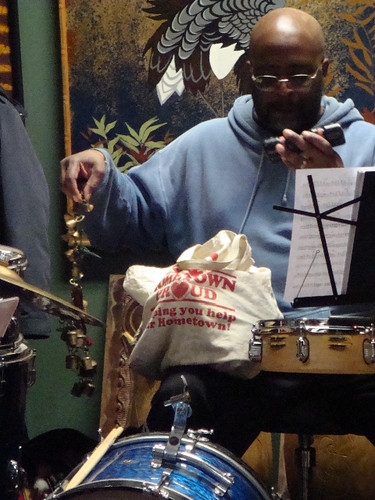
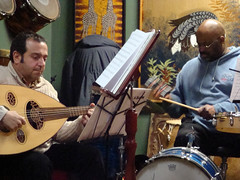
Percussionist Frake Hunsel, a Netherlander raised in Suriname, looks on as Ukrainian guitarist Alex Gorodezky works out an arrangement.

Baltimore-born drummer Ed Butler pulls something out of his bag of tricks:

Click on for larger view:


Lights, camera, action:
ELM Collective from Santa Salsera on Vimeo.
WHAT: ELM Collective
WHEN: Tuesday (2/17), 7:30-10:00 pm
WHERE: Union Cabaret, Frank Porter Graham Student Union, UNC-Chapel Hill
COST: Free, open to the public
This Raleigh jazz ensemble includes more cosmopolitan influences than you can shake a stick at. Their main instruments are Middle Eastern oud, classical guitar, funk bass, drumset, Latin keyboard and accordion, flutes and World hand percussion.
As a teaser, here are some photos from a recent ELM Collective rehearsal I attended in the upstairs space at Marsh Woodwinds.

Percussionist Frake Hunsel, a Netherlander raised in Suriname, looks on as Ukrainian guitarist Alex Gorodezky works out an arrangement.

Baltimore-born drummer Ed Butler pulls something out of his bag of tricks:

Click on for larger view:


Lights, camera, action:
ELM Collective from Santa Salsera on Vimeo.
Labels:
campus and community,
Chapel Hill,
concerts,
jazz,
Raleigh,
world fusion
update
Click here to see updated post on the 2/7 "Love in the Tropics" benefit at the Museum of Natural Science featuring Saludos Company. See photos from the party and meet a musician new to the Triangle, Victor Murillo.
Labels:
benefits and fundraisers,
Ecuador,
events,
links,
museums and galleries,
parties,
salsa
Just Like Being There
Here is some footage I took of Sin Miedo, a D.C. band led by French pianist and vocalist Didier Prossaird, in Roanoke in late January. They played the afterparty for the Arturo Sandoval concert at the Jefferson Center. Three guys from a local college are doing Cuban line-dancing in front; the one with his hat on backwards is Cuban, the others are his proteges. I danced some rueda with them later on.
Sin Miedo from Santa Salsera on Vimeo.
Alfredo Mojica is the talented vocalist and timbalero; Rene Ibanez is on congas, Steve Sachse bass, Antonio Orta sax/flute, Scott Gearhart trumpet.

Sandoval didn't show to the afterparty, but I brought along three of his Cuban sidemen--Philbert Armenteros, Manuel Valera and Alexis Arce (one of the "Pututis"). I have some more video of them sitting in with Sin Miedo... yet to come...

UPDATE
Pardon the shaky video (I'm new at this)--I wanted to edit this down but couldn't figure out what app I have that works, so, here is all 8 and a half minutes of descarga glory.
Descarga Cubana from Santa Salsera on Vimeo.
Solos: Antonio Orta - saxophone, Philbert Armenteros - congas, Alexis "Pututi" Arce - timbales.
You will see Didier directing his band, and Rene (a fellow Cubano, seen above with Philbert giving the thumbs up) setting up mics, etc. as Philbert takes the rumba seat, Pututi mans the timbales and Manuel works the keyboard like a gymnast. Hard to believe Valera's first instrument was saxophone until he came to the States in 1994! Some of you saw him here in October with Dafnis Prieto's spectacular sextet.
Related: More party photos by Garland Gay of the Roanoke Times
Sin Miedo from Santa Salsera on Vimeo.
Alfredo Mojica is the talented vocalist and timbalero; Rene Ibanez is on congas, Steve Sachse bass, Antonio Orta sax/flute, Scott Gearhart trumpet.

Sandoval didn't show to the afterparty, but I brought along three of his Cuban sidemen--Philbert Armenteros, Manuel Valera and Alexis Arce (one of the "Pututis"). I have some more video of them sitting in with Sin Miedo... yet to come...

UPDATE
Pardon the shaky video (I'm new at this)--I wanted to edit this down but couldn't figure out what app I have that works, so, here is all 8 and a half minutes of descarga glory.
Descarga Cubana from Santa Salsera on Vimeo.
Solos: Antonio Orta - saxophone, Philbert Armenteros - congas, Alexis "Pututi" Arce - timbales.
You will see Didier directing his band, and Rene (a fellow Cubano, seen above with Philbert giving the thumbs up) setting up mics, etc. as Philbert takes the rumba seat, Pututi mans the timbales and Manuel works the keyboard like a gymnast. Hard to believe Valera's first instrument was saxophone until he came to the States in 1994! Some of you saw him here in October with Dafnis Prieto's spectacular sextet.
Related: More party photos by Garland Gay of the Roanoke Times
Post-Valentine for OC Readers
Asim Unplugged from Santa Salsera on Vimeo.
Here's a video I made of my friend Asim last night, on my way home from checking out Tropic Orchestra's debut. Asim works the night shift at the Town & Country on Dixon and University, when he is not playing Pakistani festivals with his band Dil Valay.
Backstory: how I met Asim.
Subscribe to:
Posts (Atom)